
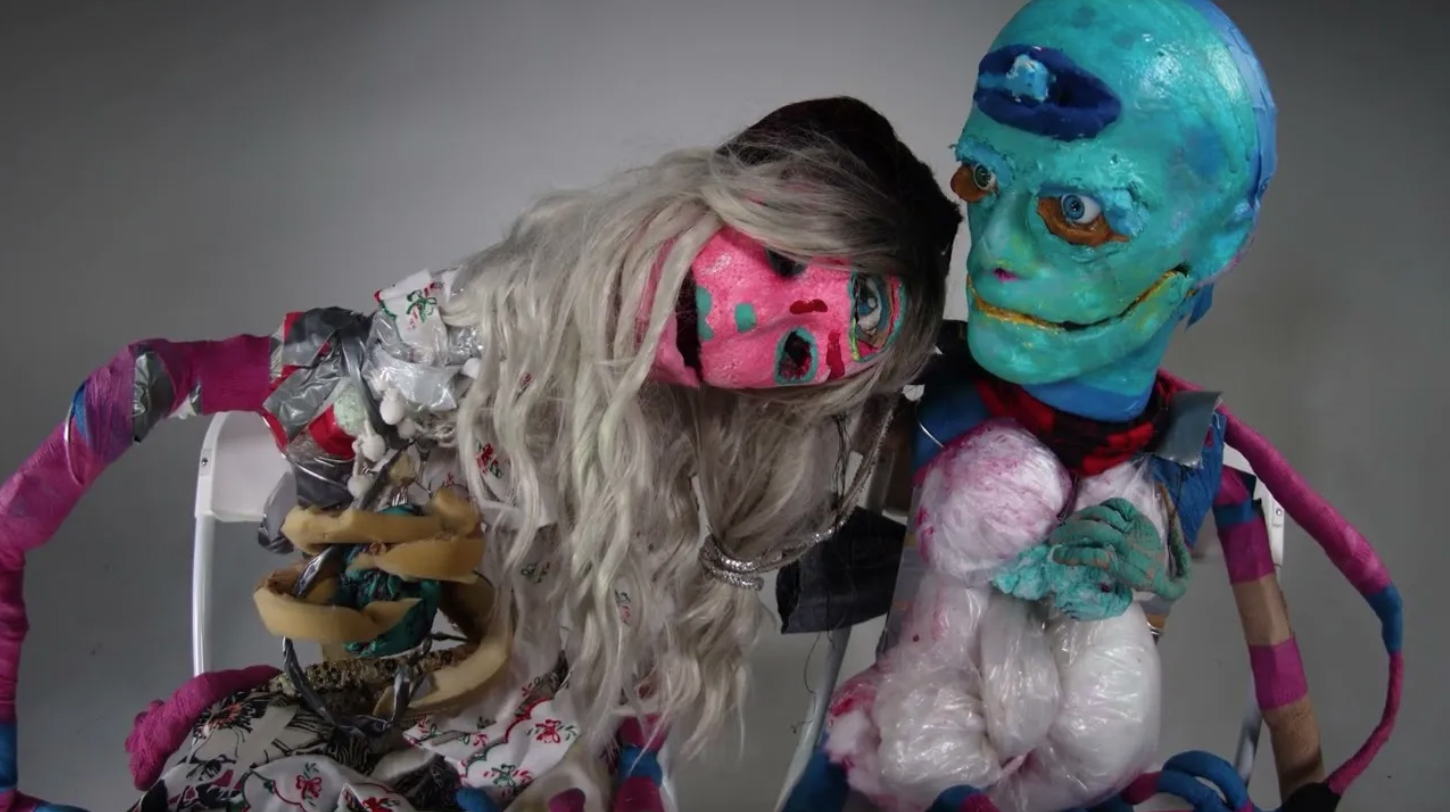

Lost Acres is the latest album from Harry Cloud, following on from 2024’s Sexy, Tooth Situation. It is also a surreal and visually stimulating full-length stop-motion animated film by Tawd B. Dorenfeld. It would not feel correct to call the music simply a “soundtrack”, as both the visual and musical elements play a mutual role and receive equal billing within this work of art. The music feels intrinsically woven into the visuals. What came first, the chicken or the egg? It certainly feels like a genuine collaboration and Cloud himself features in some scenes as a sort of blue-skinned karaoke cowboy lothario encased within a snow globe of everlasting disco winter. Oh yes, things certainly get odd in this film.
Strange creatures devour each other and themselves. Eye sockets are plugged with gum. Heads split open and contents spill, becoming amalgamated into new forms. A contortionist in bright blue Spandex wrenches their body into new shapes. Viscous fluids drip. A flamingo eats the mulch from the plughole while a stoned-looking couple get loved up, holding hands and huffing something from a plastic bag. There’s an endless cycle of decay and assimilation and rebirth.
That constant cycle of de- and reconstruction calls to mind the techniques and style of Cristobal Leon & JoaquIn Cocifia, in particular The Wolf House. It seems perhaps too obvious to invoke the name of Jan Svankmajer, but it would be evasive not to: scabrous creatures made out of remnants of creepy-looking toys and pieces of disposable Americana scuttle about the flotsam and jetsam of life. I was strongly reminded of the filth and muck of The Bolex Brothers’ classic The Secret Adventures of Tom Thumb. There’s also a kitsch aspect to the aesthetic with live action performers appearing in gaudy outfits, bizarre make-up and cheap wigs that evokes the queer/kink vibe of Tom Rubnitz’s work
Whilst it may sound chaotic, there’s a clear structure here, based around 13 episodes featuring the same motifs, themes and recurring characters (sometimes in puppet form, sometimes as actors). The film seems to convey some kind of life cycle, starting with birth in the first episode and ending quite touchingly on a peaceful and idyllic scene of friendship. Although visceral – organs and fluids featuring routinely throughout – the film is also quite tender, with lots of scenes depicting support and
love. The movie thumbnail tellingly features an unambiguously affectionate pose.”
Each episode is also soundtracked by a new piece of music by Harry Cloud. His work has always been very liberated from any conventions of traditional song writing and makes room for all forms of rock, pop, country and ambient music. However, with the visuals coloring a lot of the viewer experience, this added context seems to have freed him up to explore even more atmospheric soundscapes.
The opening track/episode ‘Friendship is Magic’, features an intriguing, mysteriou guitar composition with a haunting, elegiac quality. It perfectly soundtracks the moment of conception as Lost Acres’ characters assemble into being.
‘The National Anthem’ follows as our friends are inducted into the cultural and social norms and expectations of our times. The music features a wailing deconstructed guitar version of the U.S. National Anthem that shifts into a nevv, spacey military march as plastic soldiers advance under rippling star-spangled banners.
‘I Eat Rubber·’ does feature vocals throughout and could be considered a more formal “song”, but is one of the strangest pieces I’ve yet heard fro1n Harry Cloud. Melding genres within tracks is a hallmark of his ,work and here a minimalist Suicide-like track segues into a cheery Casio lullaby about gluttony and degradation. The astonishing ‘Skin Back’ grafts a grimy and gritty trip hop passage to a country pastiche. It’s a woozy and queasy trip. And if there’s a “single” in here, it’s ‘The Sphere’. It’s a magical, whimsical keyboard carpet ride bookended by some brilliantly catchy and crunchy glam pop.
Harry Cloud also excels at long, droning pieces that demonstrate a love for heavy sludge-mongers like Melvins and Earth, but reach further into progressive territory by the addition of keys, strings or other arresting arrangements.’The Rhombus’ is one of the most distinct parts of the film, featuring traditional animation and a deep red color palette. Dorenfeld and Cloud are out for blood! A black tarry substance is overseen by a skeletal bird-like creature as mechanical guitar tones and synth sounds
build continuously. It culminates in a crushing slab of monolithic symphonic doom rock as chaos and creation unfold on screen. At 8+ minutes it’s the centerpiece of the film and possibly the musical high watermark of Lost Acres.
‘Loam’ is a lush, fuzzy prog piece. Languid in tempo, but building in intensity, it provides a beautiful and meditative atmosphere as Lost Acres concludes with a scene of serenity, the characters freed from the constraints of their domestic lives, enjoying the simple pleasure of a sunset by the river.
With the sun setting (literally) on the film you’d be right to wonder what the next hour will entail. A caption asks us: “are you sure you saw all of that correctly?” and the film starts over again, only this time it’s been enhanced using A.I. tools. Obviously, the use of A.I. in art is a controversial matter. I remain open minded as to its potential. As
with all forms of technology, it’s about judicious application. However, in Lost Acres it doesn’t feel like this repetition of content exists for any conceptual reason, more so the result of indecision. I sense the director had the tools at his disposal and wanted to experiment, and then couldn’t decide which version to present. So, take your pick. Personally, I found the A.I. effects quite unnecessary, adding little and in fact detracting from the visual appeal of the stop motion animation, undermining the hand-made magic.
Ironically, A.I. will probably toll the death knell for stop-motion animation. Big studios can’t compete with the quick timeframes and lower costs associated with computer-generated imagery that is becoming 1nore and n1ore sophisticated. Ultimately Lost Acres is about love: not only romantic and platonic love, but love for a craft that is has become increasingly marginalized in an industry that favors cost-
– Daniel Gallagher